
The New Retirement Playbook: What Fidelity’s 2026 Study Reveals About the Future of Retirement

For decades, retirement followed a familiar script: Work hard. Save diligently. Reach age 65. Stop working. Relax.
That script is disappearing.
According to Fidelity’s 2026 State of Retirement Planning, Americans are rewriting the rules of retirement. Retirement is becoming less about reaching a finish line and more about designing a meaningful next chapter. As a certified retirement coach, I found many of the report’s findings encouraging—not because people have all the answers, but because they’re beginning to ask better questions.
Here are my biggest takeaways.
Retirement Is Becoming a Transition—Not an Event
Perhaps the most important finding in the study is that retirement is no longer viewed as a single moment.
Instead, it’s increasingly becoming a gradual transition.
Nearly 6 in 10 Americans already have a plan to ease into retirement rather than simply stop working. Many expect to:
Reduce their work hours
Take on fewer responsibilities
Transition to consulting or freelance work
Phase into retirement over several years
This reflects what I see in coaching conversations every week. People don’t necessarily want to stop contributing—they simply want more choice over how, when, and why they work.
Retirement Confidence Is Improving…
The good news: 72% of Americans believe they’ll retire on their own terms, a five-point increase from last year. Younger generations are even more optimistic, with Millennials and Gen Z expressing the greatest confidence.
That’s encouraging. But confidence isn’t the same as preparation.
…Yet Nearly One-Third Don’t Know If They’ll Ever Retire
One statistic jumped off the page.
Nearly one in three Americans aren’t sure when they’ll retire—or whether they’ll retire at all.
Why?
The reasons are revealing. The top concerns include:
Not being able to afford retirement (42%)
Wanting to stay active and engaged (38%)
Concerns about healthcare and insurance (27%)
Wanting to continue building wealth (26%)
Supporting family members financially (23%)
Notice something important?
Not all of these are financial. Many people simply aren’t ready to stop contributing.
That represents a profound shift in how we think about retirement.
The Cost of Living Is Changing Everything
Across every generation, the rising cost of living was the biggest obstacle competing with retirement savings.
People are trying to save for retirement while also managing:
Housing costs
Travel and lifestyle expenses
Emergency savings
Debt
Supporting children and aging parents
For Generation X especially, paying off debt remains a major priority. Financial planning has become more complicated than ever.
Americans Are Creating Their Own Retirement
One of my favorite findings was this: Seven out of ten Americans would consider an alternative to traditional retirement.
Many are interested in:
Starting a business
Consulting
Part-time work
Freelancing
Pursuing a different career
Gig work
In other words…People aren’t retiring from something. They’re retiring toward something.
That distinction matters.
Retirement Planning Doesn’t End When You Retire
One statistic deserves special attention: Ninety percent of respondents agreed that planning remains necessary after retirement begins.
That’s exactly right. Retirement isn’t a destination. It’s an entirely new phase of life requiring ongoing decisions about:
Income
Taxes
Healthcare
Relationships
Purpose
Time
Identity
Planning doesn’t stop. It changes.
Planning Creates Confidence
Perhaps the strongest message in the report is simple. People with a retirement plan are:
More than twice as likely to feel confident about retirement.
Among retirees, 81% who had a plan believe they’ll have enough money for the rest of their lives, compared with only 45% of those who retired without one.
Planning reduces uncertainty. And uncertainty is often what creates the most stress.
Retirement Is More Than Money
As helpful as this study is, I believe it still focuses primarily on financial preparation. That’s understandable—it’s a Fidelity study.
But in my experience as a retirement coach, the financial side is only one piece of the puzzle.
The questions that keep many retirees awake at night aren’t always: “Do I have enough money?”
They’re often:
Who am I now that I’m no longer working?
How will I spend my time?
Where will I find purpose?
How do I build meaningful relationships?
What kind of life do I actually want to create?
These questions require more than spreadsheets. They require intentional reflection.
A Retirement by Design Perspective
In my Retirement by Design framework, I encourage people to think beyond finances and intentionally design the life they want to live. That means considering ten interconnected domains of retirement:
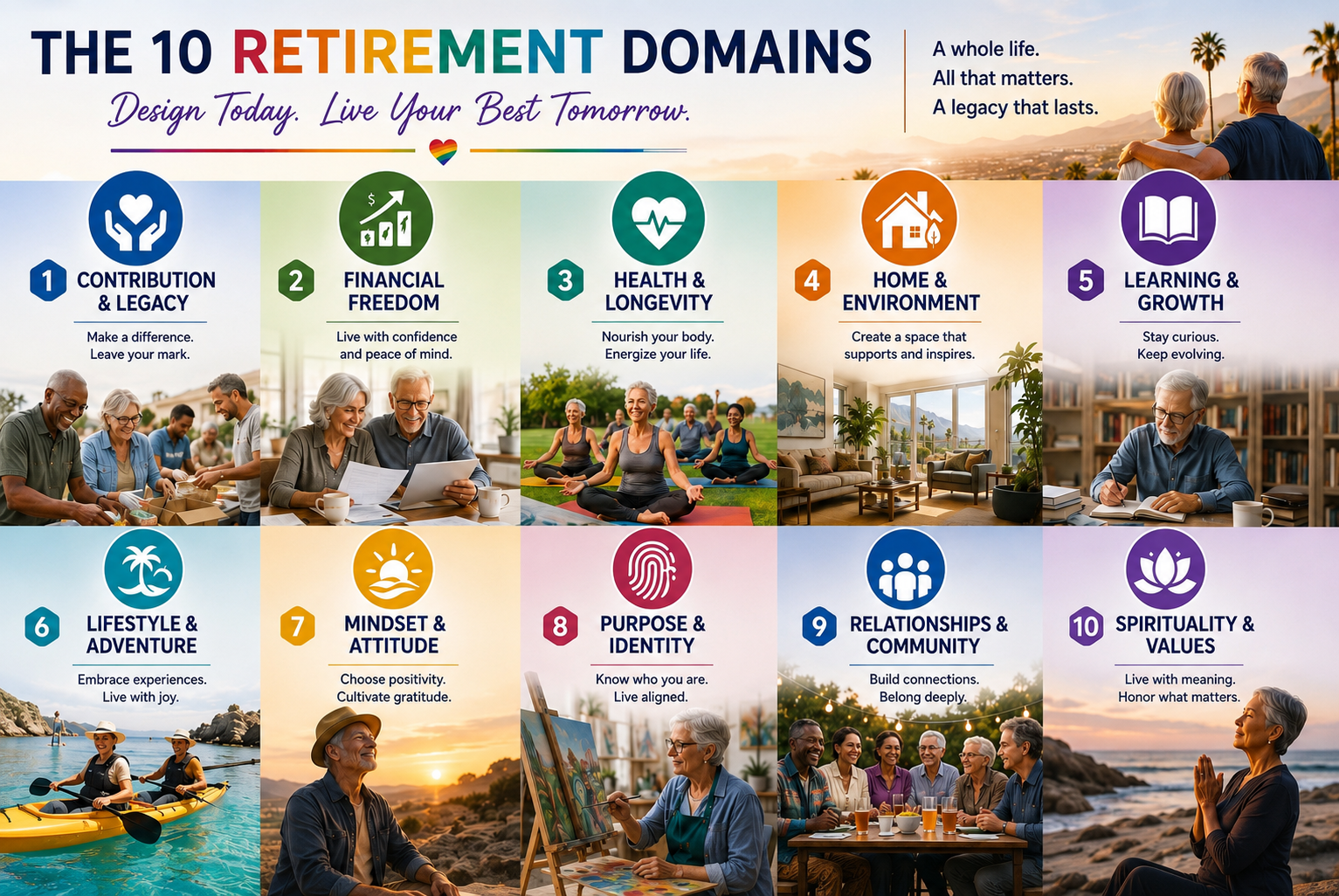
Money supports these areas—but it doesn’t replace them. Financial security gives you options. Designing your life determines what you do with those options.
Final Thoughts
The biggest insight from Fidelity’s 2026 report isn’t that retirement is changing. It’s how it’s changing.
Retirement is becoming:
More flexible than fixed.
More intentional than automatic.
More personal than traditional.
More about designing a fulfilling life than simply leaving a career.
That’s a welcome shift.
The question is no longer: “When will I retire?” The better question is: “What kind of life do I want to build once work is no longer the center of it?”
Because the most successful retirements don’t happen by accident. They happen by design.
Source:Fidelity Investments, 2026 State of Retirement Planning, based on a national survey of 2,015 U.S. adults conducted in December 2025. Available at: https://preview.thenewsmarket.com/Previews/FINP/DocumentAssets/714932.pdf
# # #
Dr. Kevin Nourse is a certified retirement coach helping people flourish in retirement. He founded Nourse Leadership Strategies, a coaching firm based in Southern California. Contact him at 760.237.0045 or by clicking here.
Retirement by Design Coaching helps individuals move beyond the financial aspects of retirement and create a meaningful, intentional, and fulfilling next chapter.
Through individual coaching, group coaching, workshops, and the Flourishing in Retirement program, participants explore the areas that shape retirement satisfaction, including purpose, relationships, health, lifestyle, identity, learning, contribution, and personal values.Retirement is too important to leave to chance.Design it with intention.
(C) Kevin Nourse, 2026
You’re welcome to reprint or share this article, provided proper credit is given and a link to the original post is included.
